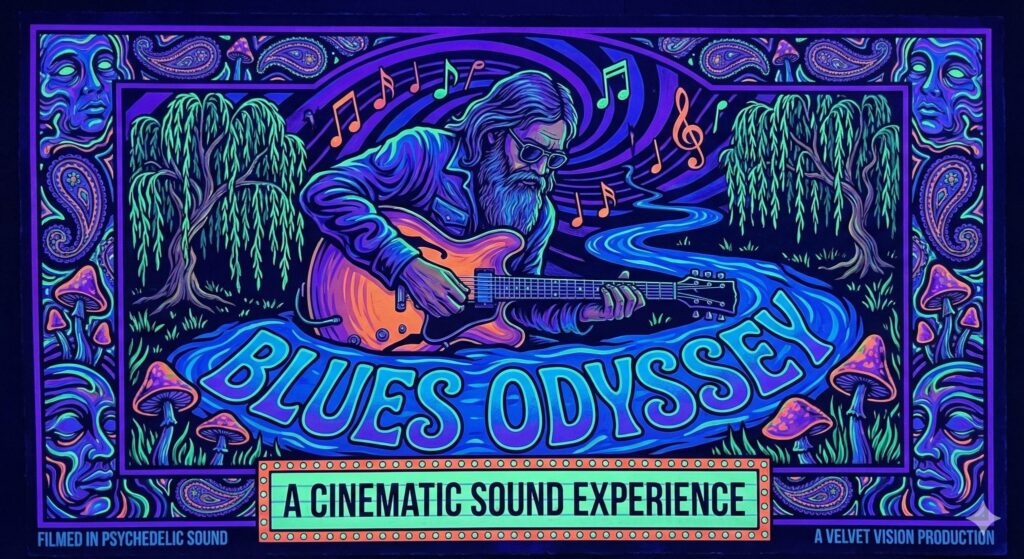
đź’ż ABOUT THE ALBUM: BLUES ODYSSEY
Every odyssey starts with a single, persistent thought. For this four-volume collection, that thought was “Can’t Believe in Hate.” That song took root in my mind and was relentless until I figured out a way to bring it to life. As you journey through this project, you will hear that central theme woven across three of the four volumes in completely different musical arrangements. It all culminates on the final track of Volume 4—presented exactly as I first heard it, driven by the stomp and clap rhythm of a gospel choir. I wanted it to be the last song you hear to leave you exactly where I started: hopefully inspired, or at the very least, entertained.
This 40-track conceptual project bridges traditional blues storytelling with groundbreaking digital session production. It traverses a vast musical landscape—from deep acoustic roots and driving Motown beats to full-scale orchestral arrangements.
Track Highlights & Commentary
- “South Side Rhythm & Motor City Rhyme” (Volume 1, Track 10): This was the very first single released from the project, and the concept hit me like a lightning bolt. I wanted to treat the legendary record labels of the mid-20th century like the Montagues and Capulets in Romeo and Juliet. On one side, you have the gritty, muddy-water blues of Chicago’s Chess Records and Memphis’s Stax; on the other, the polished, hit-making machinery of Detroit’s Motown. As the lyrics say, “They say you can’t mix the honey with the gravel.” But this track is the marriage of those two warring families. I used my digital session players to engineer a 1970s live concert console sound, blending a swampy, dirty acoustic slide guitar and heavy walking bassline with a soaring Hammond Organ and a massive soul party groove. When that smokey, high-energy vocal belts out, “You take my dusty blues and you make ’em shine / You’re my South Side rhythm with a Motor City rhyme,” it proves that Chicago and Detroit can dance all night long.
- “Can’t Believe in Hate” (Volumes 1, 3, & 4): The thematic anchor of the entire Blues Odyssey, reimagined in completely different musical arrangements across three volumes. The journey ends with the final track of Volume 4, presented as originally conceived: a raw, stomping gospel choir with a deep clap rhythm.
- “Tulsa Blues” (Volume 1, Track 1): As a Tulsa-based artist and broadcaster, I had to open Volume 1 with a Duet that is about the writing process and the pressure of writing music in Tulsa. The Midwest has a rich, gritty roots music ecosystem, and this track is a nod to that heritage. Using my digital session musicians, I was able to dial in the exact phrasing and rhythm section I needed to capture that specific, driving blues-rock groove that defines our local scene. Tulsa is always leading the way in music; I think this is the perfect place to be on the leading edge of new entertainment.
- “The Blues They Bind Us” (Volume 2, Track 1): The thesis statement for my years in broadcasting and this entire project. The blues is the connective tissue of American roots music. The goal was to capture a groove that feels both historically grounded and entirely timeless.
- “Dead Zone” & “Dead Zone Pub Song” (Vol 1, Track 3 & Vol 2, Track 4): The lyrics to “Dead Zone” tackle a modern tragedy: our profound disconnection from society through the digital ecosystem. It is a narrative about a “pay-to-play world” and the slow-motion violence of the digital divide between those who have access and the “digital ghosts” who don’t. When I wrote lines like, “You got a window to the ocean… But you can’t see your neighbor through the gated bars,” I knew the message needed two distinct lives. On Volume 1, you get the driving, atmospheric studio arrangement reflecting that cold, artificial light. For Volume 2, I stripped it down to an intimate, acoustic “Pub Song” alternative take, bringing the song out of the digital void and back into the physical, human connection of a smoky, vintage pub.
- “Two Ancient Peoples Choctaw & Irish (The Story of 1847)” (Volume 2, Track 6): Deep historical storytelling about the Choctaw Nation sending relief to the Irish during the Potato Famine. Directing my digital studio assets allowed me to weave ancient and traditional acoustic instruments together into a single, emotional narrative track.
- “Unmarked Grave (Story of Ota Benga)” (Volume 1, Track 6): A deeply historical and tragic narrative honoring the story of Ota Benga. As the project’s architect, I commanded the pacing, the rests, and the haunting background arrangements to ensure the music honored the gravity of his story.
- “Bluin’ the Blues” (Volume 4, Track 4): This track served as the very first sneak peek into the Blues Odyssey universe. Clocking in at nearly seven minutes, it is a sprawling, slow-burning masterclass in traditional blues instrumentation. I charted the chords and dictated the BPM to create a groove that breathes and takes its time, proving that modern studio technology can still capture the soul and swing of vintage, slow-drag blues. I also stepped up to the mic to sing the lead vocals on this arrangement myself—completely raw with zero autotune, so be kind LOL!
🎛️ THE PRODUCTION PROCESS (FAQ)
Q: What do you mean by “digital session musicians”? A: Think of it like hiring a world-class studio band, but entirely in the digital realm. I use advanced AI software to perform the instruments and execute the arrangements I create. As the project’s architect, I direct the BPM, the phrasing, the vocal ranges, and the style. The software then plays the parts I dictate—whether I need a solo acoustic guitar, a driving rhythm section, or a full orchestra.
Q: Did AI write the music or the lyrics? A: Not at all. Every single lyric, chord progression, and core melody on Blues Odyssey is 100% original and written by me. The AI is simply the instrument I used to perform the music, much like how a producer directs session players in a physical studio. I also provide human vocal performances and handle the traditional studio enhancements and mastering.
Q: Why use digital session players instead of a traditional studio band? A: The sheer scale of this 40-track project demanded it. One track might require a gritty Tulsa blues-rock setup, while the next needs a Motown horn section, a stomping gospel choir, or ancient traditional instruments. Utilizing digital session musicians gave me the unprecedented freedom to access all of these sounds instantly.
Q: Is using AI in music a new concept? A: The collaboration between human creativity and AI has actually been evolving within studio software for many years. Even legends like Sir Paul McCartney have utilized AI tools to finalize their artistic visions. I look at it as the next evolution of production—it is very much like pairing a classic 70s analog recording board with today’s modern digital effects.
EPK For The Album here
Volume 1
Volume 2
Volume 3
Volume 4